 Capitol Square
 CSRAB
CSRAB
 Museum Shop
 Parking
 News Media
 Capitol Square Foundation
 Public Tours
 School and Group Tours
 Self-Guided Tours
 Museum Education Center
 Battery A
 Great Ohioans
 Governor Portraits
 George Washington Williams Room
 County Flags
 Ohio Presidents
 Ladies' Gallery
 Museum Collections Catalog
 Holiday Santa Photos 2025
 Flags for 9-11 in 2025
 2025 Volunteer Appreciation Dinner
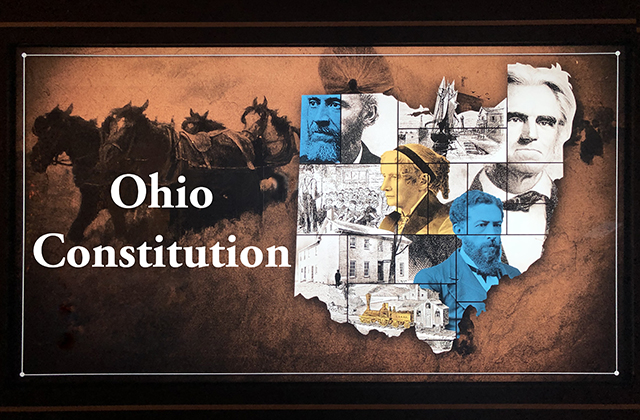 Ohio Constitution Videos
 Ohio Statehouse Videos
 News Archive
 Mailing List
 Your Event
 Weddings





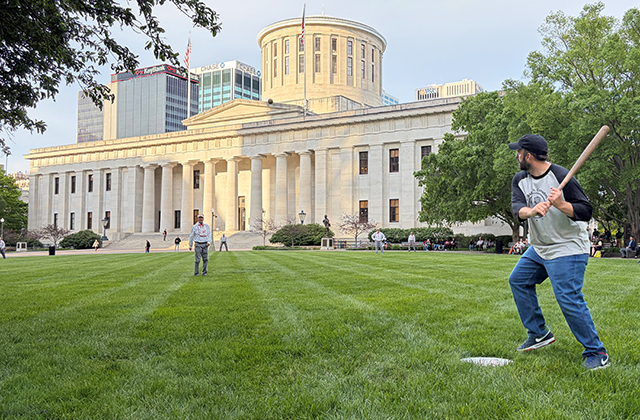 Vintage Base Ball 2026
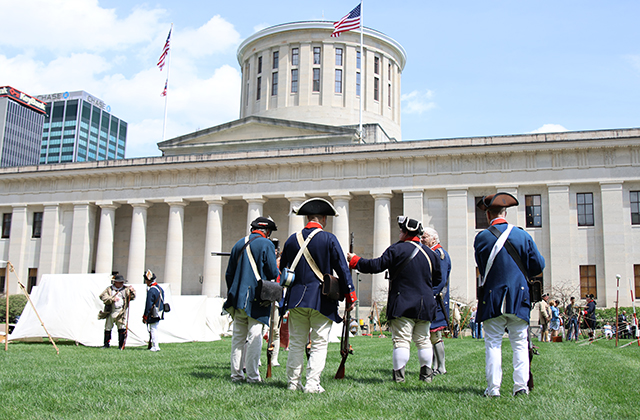 American Revolution in the Ohio Country - 250
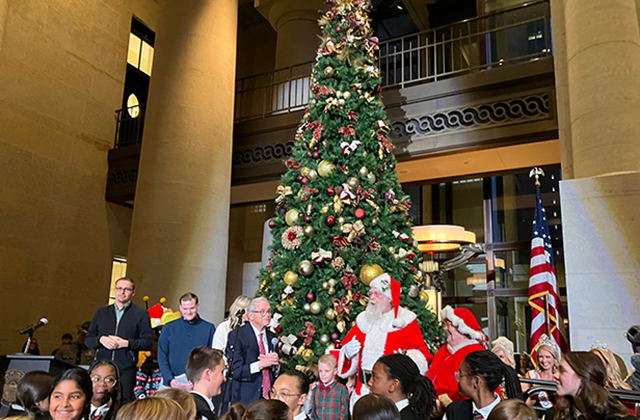 Holiday Festival and Tree Lighting 2025





The Ohio STatehouse and the Ohio National Guard have partnered to present a free public program to commemorate the 200th anniversary of the beginning of the War of 1812. The program will take place on Monday, June 18 at 11:30 a.m. on Veterans Plaza on the east side of the Capitol Square complex. In the event of inclement weather, the ceremony will take place in the Ohio Statehouse Rotunda. The presentation is free and open to the public.
The ceremony will include the reading of the declaration of war, raising of a 15 star U.S. flag on the Statehouse grounds and a “ringing of the bells for 1812” at noon in conjunction with the United States Daughters of 1812 nationwide event. The ceremony will be broadcast live on the Ohio Channel and Web streamed live on the Internet at www.ohiochannel.org.
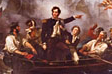
The Ohio Statehouse Rotunda houses the painting, Perry’s Victory, which depicts a key battle of the War of 1812, The Battle of Lake Erie, in which Oliver Hazard Perry led the American forces to victory over the British. Perry’s flagship, the Lawrence, had caught fire and his crew suffered heavy casualties. The painting was the first piece of artwork commissioned by the state of Ohio for the new 1861 Statehouse.
The survivors, including Perry, rowed to another American ship, the Niagara, and continued the battle, outmaneuvering the British. Oliver Hazard Perry, commanding the American fleet, met up with the British off the Bass Islands in Lake Erie and soundly defeated them. This action effectively gave control of the lake to the Americans, and led to General William Henry Harrisons’ invasion of Canada. Perry is famous for his statement during the final stages of the battle, “We have met the enemy and they are ours.”
Ohio artist William Powell created the painting. But after completing it, Powell asked for three times the agreed-upon price, refusing to give up the painting. Instead, he exhibited the painting around the nation and received another commission for a similar piece which now hangs in the U.S. Capitol in Washington, D.C. Finally, the State of Ohio met Perry’s higher price, and the painting hangs in the Rotunda at the Ohio Statehouse.
About the War of 1812
In the War of 1812, the United States took on the greatest naval power in the world, Great Britain, in a conflict that would have an immense impact on the young country's future. Causes of the war included British attempts to restrict U.S. trade, the Royal Navy's impressment of American seamen and America's desire to expand its territory.
President James Madison requested a declaration of war to protect American ships on the high seas and to stop the British from impressing or seizing U.S. sailors. U.S. ships were being stopped and searched by both Great Britain and France, who were fighting each other in Europe. American attempts to invade Canada during the war failed but U.S. forces won a number of important naval battles. Americans saw the War of 1812 as a triumph that showed the new nation could fend off foreign threats.
The United States suffered many costly defeats at the hands of British, Canadian and Native American troops over the course of the War of 1812, including the capture and burning of the nation's capital, Washington, D.C., in August 1814. Nonetheless, American troops were able to repulse British invasions in New York, Baltimore and New Orleans, boosting national confidence and fostering a new spirit of patriotism. The ratification of the Treaty of Ghent on February 17, 1815, ended the war but left many of the most contentious questions unresolved. Nonetheless, many in the United States celebrated the War of 1812 as a "second war of independence," beginning an era of partisan agreement and national pride.