 Capitol Square
 CSRAB
CSRAB
 Museum Shop
 Parking
 News Media
 Capitol Square Foundation
 Public Tours
 School and Group Tours
 Self-Guided Tours
 Museum Education Center
 Battery A
 Great Ohioans
 Governor Portraits
 George Washington Williams Room
 County Flags
 Ohio Presidents
 Ladies' Gallery
 Museum Collections Catalog
 Holiday Santa Photos 2025
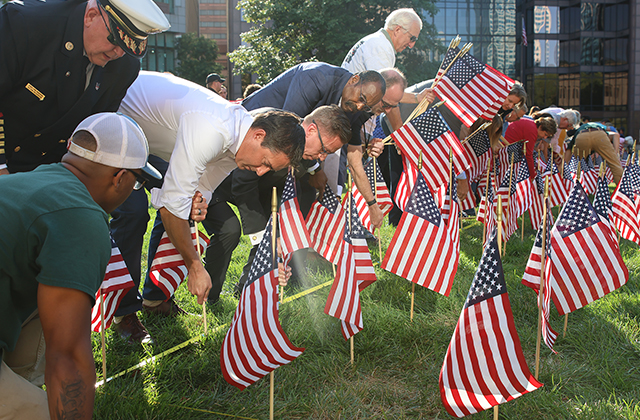 Flags for 9-11 in 2025
 2025 Volunteer Appreciation Dinner
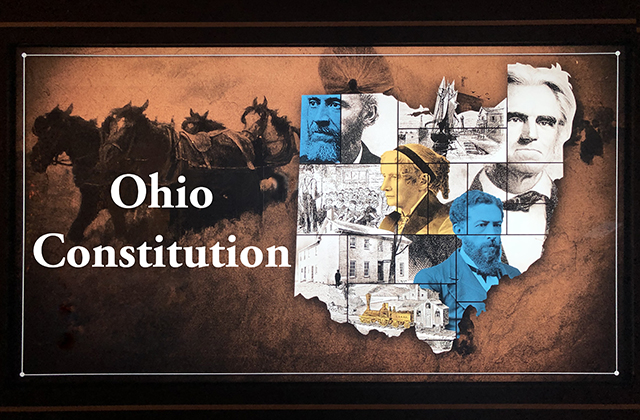 Ohio Constitution Videos
 Ohio Statehouse Videos
 News Archive
 Mailing List
 Your Event
 Weddings





 Vintage Base Ball 2026
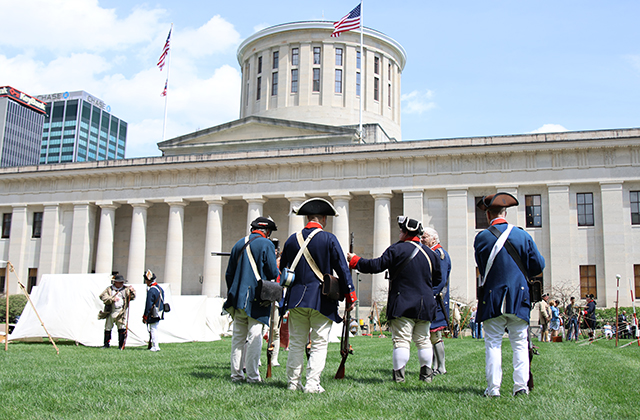 American Revolution in the Ohio Country - 250
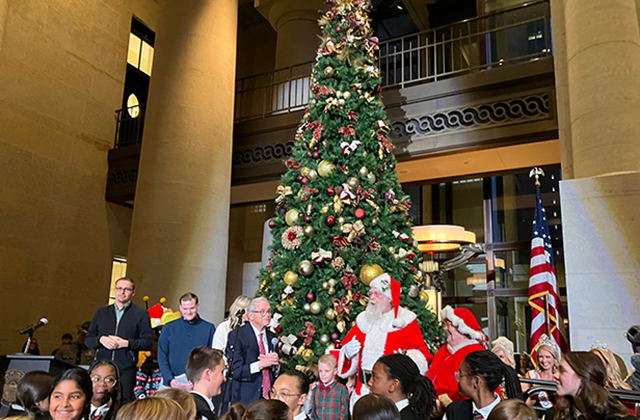 Holiday Festival and Tree Lighting 2025





Red Carnation Day at the Ohio Statehouse
Honoring Assassinated President William McKinley
September 14, 2012
Ohio Statehouse, Broad & High Streets; downtown Columbus
614/752-9777
Free!
The Ohio Statehouse will observe the 111th anniversary of Ohio Governor and U.S. President William McKinley’s death in September with its annual Red Carnation Day. The day-long commemoration honors McKinley and his contributions to Ohio, the country and world while serving as Ohio Governor and U.S. President. The day of remembrance will take place on Friday, September 14.
Individuals wearing a red carnation or dressed in scarlet during this special day will receive a 20% discount on one item (some exclusions apply) in the Statehouse Museum Shop and a 10% discount on purchases in the Capitol Cafe. The shop and cafe are located on the ground floor of the Ohio Statehouse. Red Carnation Day will also feature information highlighting McKinley during Statehouse tours.
The day of remembrance also includes a special McKinley exhibit and looping video montage that will be on view in the Ohio Statehouse Rotunda. The video presentation consists of 12 rare, early film clips called actualities, that document President McKinley reviewing troops and giving a speech at the 1901 Pan-American Exposition in Buffalo, New York, the day before his assassination; the scene of a crowd exiting the “Temple of Music” just moments after McKinley was shot by Leon F. Czolgosz; and McKinley’s funeral procession at Buffalo, New York, Washington, D.C. and Canton, Ohio. The piece concludes with an unusual early film clip called “The Martyred Presidents,” a vignette paying tribute to Abraham Lincoln, James Garfield and William McKinley, all of whom were assassinated in office.
The film was created by Thomas A. Edison, Inc. and is from the collections of the Library of Congress.
About the State Flower and its Connection to William McKinley
President William McKinley was assassinated in 1901 during a visit to the Pan American Exposition in Buffalo, NY. Shot twice with a hand gun, President McKinley survived eight days before his death on September 14. On February 3, 1904, the Ohio General Assembly enacted legislation making the scarlet carnation the state flower. This was done specifically to honor William McKinley, Ohio Governor (1892-1896) and U.S. President (1897-1901), who regularly wore this type of flower on his lapel.
McKinley’s floral signature goes back to the election of 1876, when he was running for a seat in the United States Congress. His opponent for the seat was Levi Lamborn, of Alliance, Ohio. Lamborn was a physician and keen amateur horticulturist, and had developed a strain of bright scarlet carnations he dubbed “Lamborn Red.” Dr. Lamborn presented McKinley with a “Lamborn Red” boutonniere before their debates, and after his election victory, the future President saw the red carnation as a good luck charm. He wore one on his lapel regularly and presented visitors to his office carnations from a vase. Moments before he was shot by an assassin, it is reported that McKinley had removed the carnation from his lapel and presented it to a young girl. Dr. Lamborn was instrumental in efforts to enact the legislation that made the scarlet carnation the state flower of Ohio. In 1959, the Ohio Legislature named Alliance, Ohio “the Carnation City.”